

Introduction: Being Online Is Not the Same as Growing Online
A business can have an attractive website, active social media profiles, and a monthly advertising budget yet still struggle to generate consistent customer inquiries.
This happens more often than many business owners expect.
The problem is not always a lack of marketing activity. Sometimes businesses invest in several channels without understanding how those channels contribute to their goals.
Customers have also changed the way they make decisions. They research services through Google, explore AI-generated recommendations, compare social media profiles, read reviews, and evaluate multiple providers before making contact.
In 2026, successful Online Business Growth Strategies must address these behaviors rather than depend on a single marketing platform.
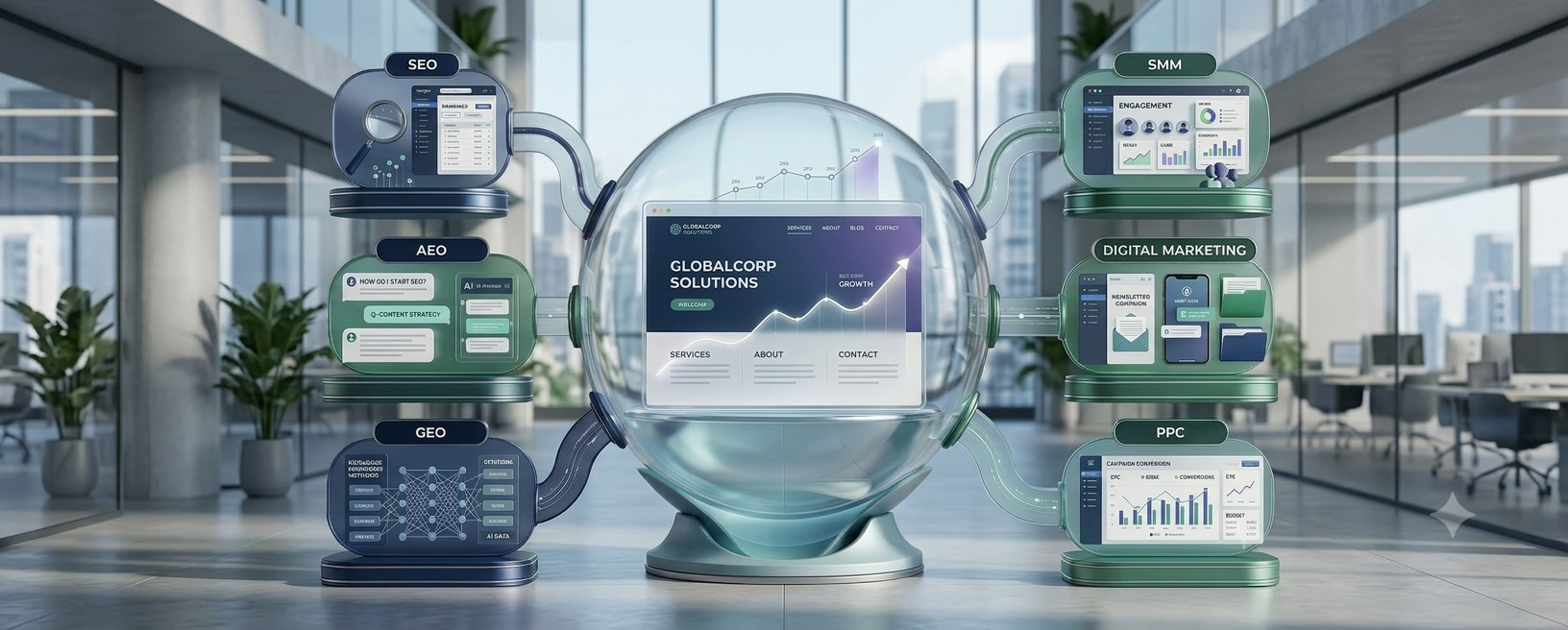
At SEOAD, the available services cover Search Engine Optimization (SEO), Answer Engine Optimization (AEO), Generative Engine Optimization (GEO), Social Media Marketing (SMM), Digital Marketing (DM), and Pay Per Click (PPC).
Understanding how these services solve specific business challenges is the first step toward creating a more effective marketing strategy.
Challenge 1: Your Website Exists, but Customers Cannot Find It
Imagine opening a beautiful showroom on a street that hardly anyone visits. That is how an unoptimized website often performs.
Even excellent products can remain undiscovered when website content does not match what customers search for.
On-Page SEO helps improve website headings, titles, internal links, and page content. It makes important information clearer to visitors and search engines.
Off-Page SEO builds credibility through relevant external references, earned backlinks, and brand mentions.
For product-based websites, E-Commerce SEO improves category pages, product descriptions, and shopping-related discoverability.
Content SEO creates useful articles and resources based on real customer questions.
A company targeting nearby customers can benefit from Local SEO, while businesses operating across language markets may use Multilingual SEO to provide localized content.
For example, a Chennai-based machinery supplier could develop product-specific pages, technical guides, and regional landing pages to address different customer requirements.
The solution: Build a website around what customers need to know, not simply what the business wants to promote.
Challenge 2: Customers Are Using AI, but Your Brand Is Missing From Their Research
A growing number of customers use conversational AI to understand services, compare alternatives, and prepare purchasing decisions.
This creates another opportunity for businesses to make their information accessible.
Answer Engine Optimization (AEO) focuses on clear explanations, useful answers, structured content, and trustworthy business information.
SEOAD's AEO services address platforms such as ChatGPT, Google Gemini, Microsoft Copilot, Perplexity, Claude AI, Meta AI, and You.com.
Consider a customer asking an AI assistant:
"What should I consider before choosing an SEO agency for my business?"
A company with detailed service descriptions, helpful educational resources, clear contact details, and verifiable expertise offers information that may assist this research process.
However, AI platforms use different information sources. Being optimized does not guarantee a recommendation or citation.
The solution: Publish genuinely useful, accurate content that answers important customer questions without exaggerated promises.
Challenge 3: Your Business Has Expertise, but the Market Does Not Recognize It
Some companies deliver excellent services yet communicate very little about their expertise online.
This makes it difficult for potential customers to distinguish them from competitors.
Generative Engine Optimization (GEO) focuses on improving how brands and their information may be represented in AI-assisted discovery.
SEOAD identifies Google Search AI, Microsoft Bing AI, DuckDuckGo AI, and Substack within its GEO-related offerings.
These platforms have different functions. Search engines integrate AI-powered features, while Substack supports publishing, newsletters, and expert-audience development.
Businesses can strengthen their credibility by publishing detailed case studies, original insights, technical explanations, expert commentary, and consistent company information.
For example, an engineering consultancy could demonstrate its experience through project explanations, methodology articles, and educational resources.
The solution: Make expertise visible through evidence, helpful information, and consistent digital communication.

Challenge 4: Social Media Activity Is Not Producing Business Opportunities
Posting frequently does not automatically create customers.
Some businesses publish promotional graphics every day without explaining the value of their services or engaging meaningfully with their audiences.
A better Social Media Marketing (SMM) strategy matches content with the strengths of each platform.
Facebook Marketing supports community interaction and customer communication.
Instagram Marketing helps businesses demonstrate products, projects, and brand personality visually.
LinkedIn Marketing is valuable for professional networking, B2B communication, and industry expertise.
X (Twitter) Marketing supports timely conversations and business updates.
YouTube Marketing makes it possible to explain services through tutorials, demonstrations, and educational videos.
TikTok Marketing can introduce products through short-form videos, while Pinterest Marketing supports visual product and idea discovery.
Reddit Marketing can help companies understand niche communities and contribute useful expertise when participation follows community rules.
Local businesses should also maintain Google My Business, now called Google Business Profile, and accurate location information through Bing Map Promotion.
The solution: Choose relevant platforms, publish useful content, and measure meaningful customer engagement rather than posting frequency alone.
Challenge 5: Visitors Show Interest but Never Become Customers
Website traffic and social media engagement have limited business value if prospective customers cannot find a clear path toward making an inquiry.
That is where broader Digital Marketing (DM) activities become important.
WhatsApp Marketing supports permission-based customer conversations, appointment scheduling, and timely follow-ups.
Email Marketing helps businesses maintain relationships through newsletters, educational content, and relevant offers.
Video Marketing can simplify complicated products and services.
Regular Blog Posting answers customer questions and supports long-term content discovery.
Quora Marketing creates opportunities to demonstrate expertise through relevant answers.
Businesses can also participate in Forum & Microblogging communities to share insights and build professional relationships.
Classified Listing can support discoverability through suitable directories, while Link Submission should focus on reputable, relevant platforms rather than low-quality backlink schemes.
Wikipedia Services must follow neutral editorial standards, reliable sourcing, and conflict-of-interest guidelines rather than promotional objectives.
Importantly, Reputation Management helps businesses respond professionally to reviews, address concerns, and maintain customer confidence.
The solution: Give potential customers a clear reason to return, ask questions, and begin a conversation.

Challenge 6: Advertising Budgets Are Increasing, but Leads Remain Unpredictable
Paid advertising can bring attention quickly, but poorly planned campaigns often attract clicks without producing valuable inquiries.
Effective Pay Per Click (PPC) campaigns begin with audience research and clear conversion goals.
Google Ads can reach customers who are actively searching for relevant products or services.
Meta Ads can support targeted awareness, engagement, and lead-generation campaigns across eligible Meta platforms.
YouTube Advertising allows companies to introduce products or explain services through video advertisements.
For example, a business selling industrial equipment may achieve better results by promoting specific products to relevant search audiences than by advertising its entire company to a broad audience.
The landing page must also match the advertisement and make it easy for customers to take the next step.
The solution: Measure qualified inquiries, conversion costs, and business outcomes instead of treating clicks as proof of success.
A Better Approach: Connect Marketing to Real Business Objectives
The strongest marketing plan does not necessarily use every available service.
It selects the right combination based on customers, competition, budget, and business maturity.
A local service company might prioritize Google visibility, reviews, and lead-focused advertising.
An e-commerce business may concentrate on product-page optimization, social campaigns, and customer retention.
An international B2B company could benefit from multilingual content, technical expertise, LinkedIn activity, and targeted search advertising.
Different businesses need different combinations.
How SEOAD Supports Business Visibility
SEOAD is a Chennai-based digital marketing agency offering traditional search optimization, AI-oriented visibility, social media services, digital marketing, and paid advertising.
The company emphasizes manual, white-hat marketing methods and customized approaches to improving online visibility.
Its service portfolio allows businesses to explore different marketing channels according to their priorities.
Rather than investing in activities without direction, organizations can focus on services that address their most important growth challenges.
Frequently Asked Questions
1. Why do businesses struggle to generate leads despite having a website?
Common reasons include poor search visibility, unclear messaging, weak conversion pages, limited trust signals, and marketing campaigns that do not match customer intent.
2. What is the difference between SEO, AEO, and GEO?
SEO improves search engine visibility. AEO supports clear, answer-focused content. GEO addresses brand discoverability and representation in generative AI experiences.
3. Can AI search optimization guarantee business recommendations?
No. AI responses depend on platform-specific systems and information sources. Good optimization practices can improve information quality and accessibility, but recommendations cannot be guaranteed.
4. Which social media platform is best for business marketing?
It depends on the audience. LinkedIn is often useful for B2B marketing, Instagram for visual brands, and YouTube for demonstrations and educational content.
5. Is PPC advertising better than organic SEO?
PPC provides paid visibility and can support faster campaign testing, while SEO develops longer-term organic discoverability. Both can complement each other.
6. How does reputation management help businesses?
It supports customer trust by encouraging professional responses to feedback, maintaining accurate business information, and addressing public concerns.
7. Can small businesses use these digital marketing strategies?
Yes. Small businesses can begin with a focused website, local search presence, customer reviews, and a limited number of relevant marketing channels.
8. How can businesses measure digital marketing success?
Important indicators include qualified leads, customer inquiries, conversion rates, acquisition costs, organic visibility, and revenue attributable to marketing efforts.
9. Does SEOAD provide services for AI-powered search platforms?
Yes. SEOAD lists AEO and GEO services for a range of AI assistants and search experiences, alongside its traditional SEO and digital marketing offerings.
10. What should a business improve first?
Start by identifying its biggest obstacle: insufficient visibility, weak engagement, low conversion rates, or ineffective advertising. Then prioritize the services that directly address that challenge.
Conclusion: Solve the Marketing Problem Before Increasing the Budget
Business growth does not depend on being present everywhere.
It depends on being visible where customers search, providing information they can trust, maintaining meaningful relationships, and making it easy to take action.
SEO helps customers discover your website. AEO and GEO address newer information-discovery experiences. Social media creates opportunities for engagement, digital marketing supports customer relationships, and paid advertising can accelerate targeted acquisition.
When these activities serve a clear business objective, marketing becomes more focused and measurable.
Looking for a more effective way to improve your digital presence?
Explore SEOAD's services at https://seoad.in/ and identify the marketing opportunities most relevant to your business.