

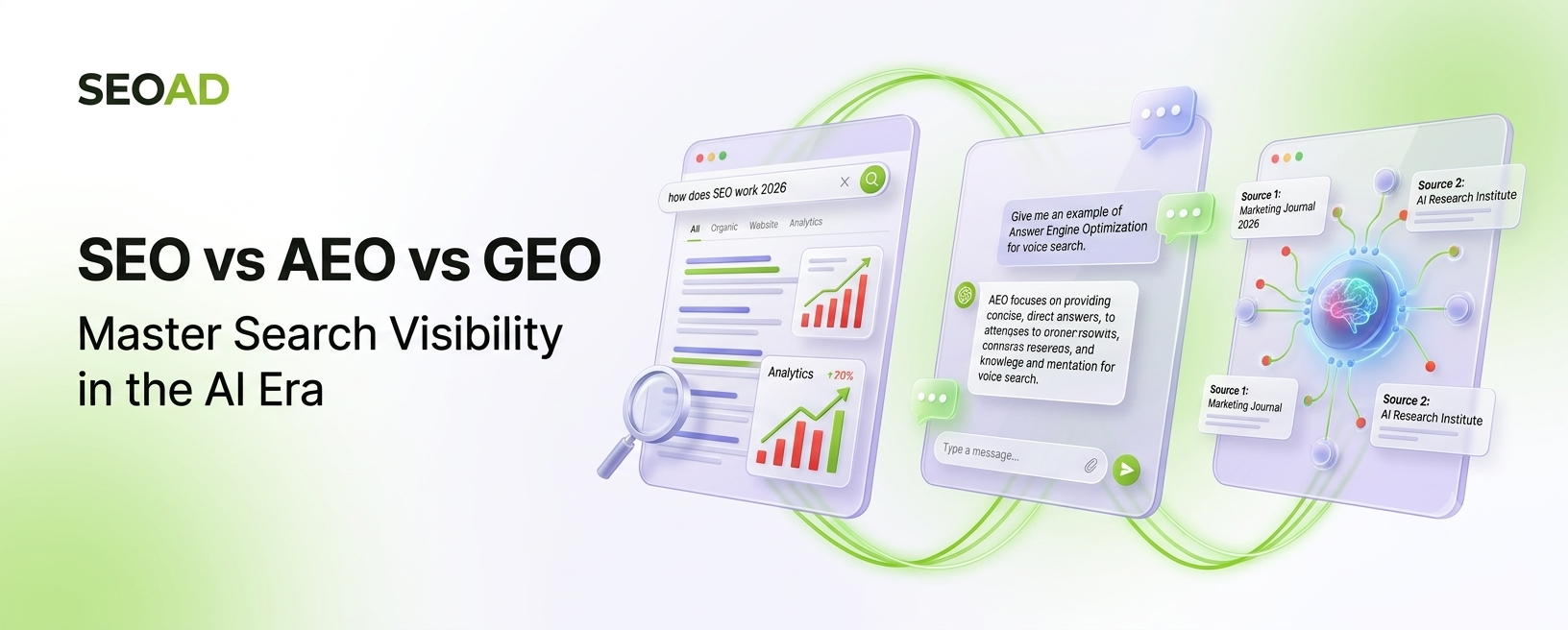
The digital search landscape is transforming rapidly. Traditional search engines such as Google and Bing are no longer the only places where customers discover businesses. AI-powered platforms such as ChatGPT, Google Gemini, Microsoft Copilot and Perplexity are changing how people search for information, compare services and make purchasing decisions.
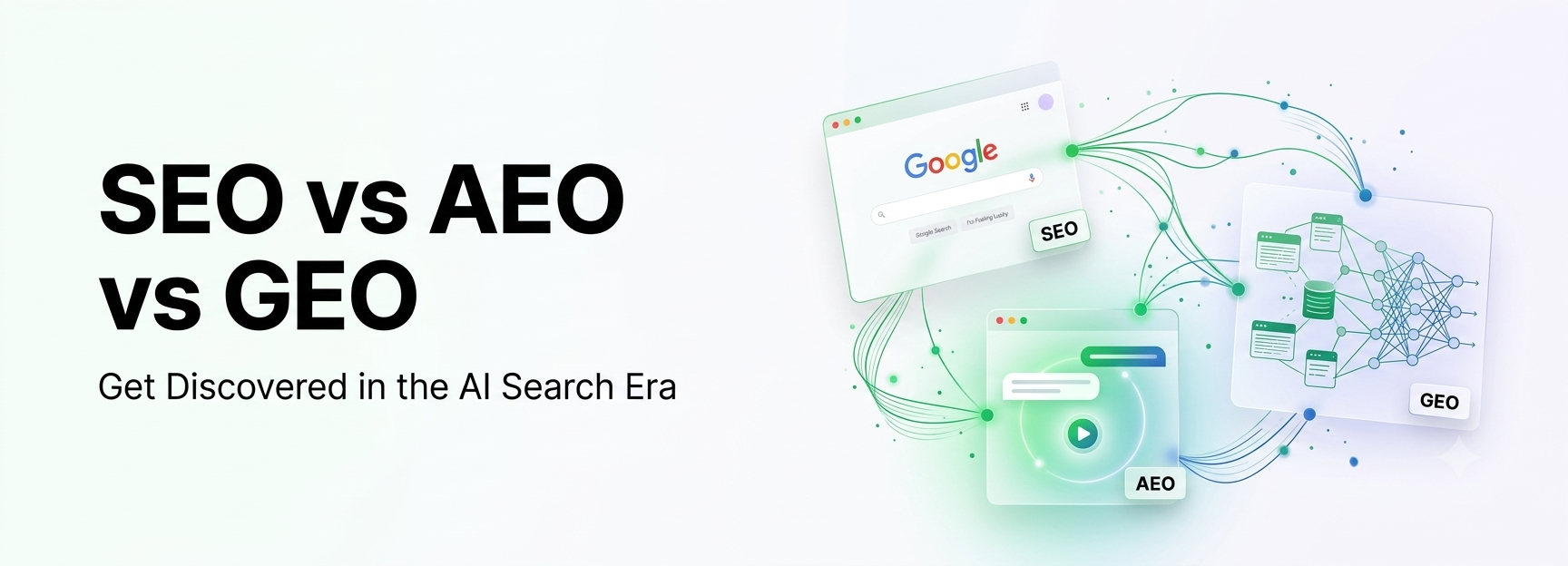
Businesses that previously focused only on traditional Search Engine Optimization (SEO) are now exploring Answer Engine Optimization (AEO) and Generative Engine Optimization (GEO) to expand their online visibility.
But what exactly is the difference between SEO, AEO and GEO? Which strategy should businesses prioritize in 2026?
Understanding these approaches can help companies build a digital marketing strategy that supports both traditional search rankings and AI-powered discovery.
What Is SEO (Search Engine Optimization)?
Search Engine Optimization (SEO) is the process of improving a website's visibility in organic search engine results.
SEO helps businesses attract relevant visitors when potential customers search for products, services or information on platforms such as Google and Bing.
For example, when someone searches for "best digital marketing agency in Chennai," search engines evaluate relevant websites and display results based on their ranking systems.
An effective SEO strategy involves several important activities:
-
On-Page SEO Optimizing page titles, headings, website content and internal links.
-
Off-Page SEO Building brand authority through relevant backlinks, mentions and digital PR.
-
E- commerce SEO Improving crawlability, indexing, website speed and mobile usability.
-
Local SEO Increasing visibility in location-based searches and Google Business Profile listings.
-
Content SEO: Publishing useful, original and keyword-relevant website content.
SEO remains essential because organic search continues to connect businesses with people actively looking for solutions.
However, search behavior is expanding beyond conventional search engine result pages.
What Is AEO (Answer Engine Optimization)?
Answer Engine Optimization (AEO) focuses on making website content easy for search systems and AI-powered assistants to understand and use when answering questions.
Instead of only targeting a high-ranking webpage, AEO emphasizes providing clear, accurate and useful answers to common user questions.
For example, someone might ask ChatGPT:
"What is the difference between SEO and digital marketing?"
An AI assistant may generate a direct explanation using its existing knowledge or information retrieved from external sources, depending on the product and search mode.
Businesses can support answer visibility by publishing content that directly addresses questions related to their expertise.
Important AEO Techniques
1. Answer common customer questions
Identify frequently asked questions about your services and provide useful explanations.
2. Use clear headings
Organize content with descriptive H2 and H3 headings that match real search questions.
3. Create accurate FAQ sections
Develop relevant questions and answers that genuinely help visitors understand your products or services.
4. Use appropriate structured data
Add supported schema markup where applicable, ensuring it accurately reflects visible page content.
5. Demonstrate expertise
Include original explanations, credible references, real examples and updated information.
AEO can support visibility across experiences involving ChatGTP, Google Gemini, Perplexity and Microsoft Copilot. However, no optimization method can guarantee that a particular AI assistant will mention a business.
What Is GEO (Generative Engine Optimization)?
Generative Engine Optimization (GEO) is a strategy aimed at improving how businesses and their content are discovered, understood, referenced or cited within AI-generated responses.
Generative AI systems can combine information from multiple sources to produce detailed answers.
For example, a user may ask:
"Which digital marketing strategies should a small business use to generate leads in 2026?"
An AI-powered search experience may gather information from relevant sources and generate a comprehensive response covering SEO, content marketing, paid advertising and social media.
GEO aims to make a business's content a useful and credible source for such responses.
Effective GEO Strategies
Publish original research and insights
Create informative articles supported by first-hand experience, practical examples and credible data.
Strengthen brand credibility
Maintain accurate company information, demonstrate expertise and earn genuine recognition from relevant industry websites.
Improve content accessibility
Ensure important information is available as readable webpage text and that search engines can access relevant pages.
Maintain accurate, updated information
Review content regularly and correct outdated information, especially for rapidly changing industries.
Build topic authority
Publish interconnected resources that explain your services, answer customer questions and demonstrate subject knowledge.
GEO is not a shortcut to guaranteed AI citations. Its value lies in making information more useful, discoverable and trustworthy across search experiences.
SEO vs AEO vs GEO: Key Differences
Although these approaches are connected, they emphasize different aspects of online visibility.
|
Feature |
SEO |
AEO |
GEO |
|
Primary focus |
Organic search visibility |
Direct answer usefulness |
AI-generated answer visibility |
|
Main objective |
Earn relevant search traffic |
Provide clear answers |
Become a useful referenced source |
|
Content priority |
Relevant, helpful webpages |
Question-focused explanations |
Credible, original information |
|
Common channels |
Google, Bing |
AI assistants and answer interfaces |
AI search and generative responses |
|
Typical measurement |
Rankings, clicks, conversions |
Answer appearances, engagement |
AI mentions, citations, referrals |
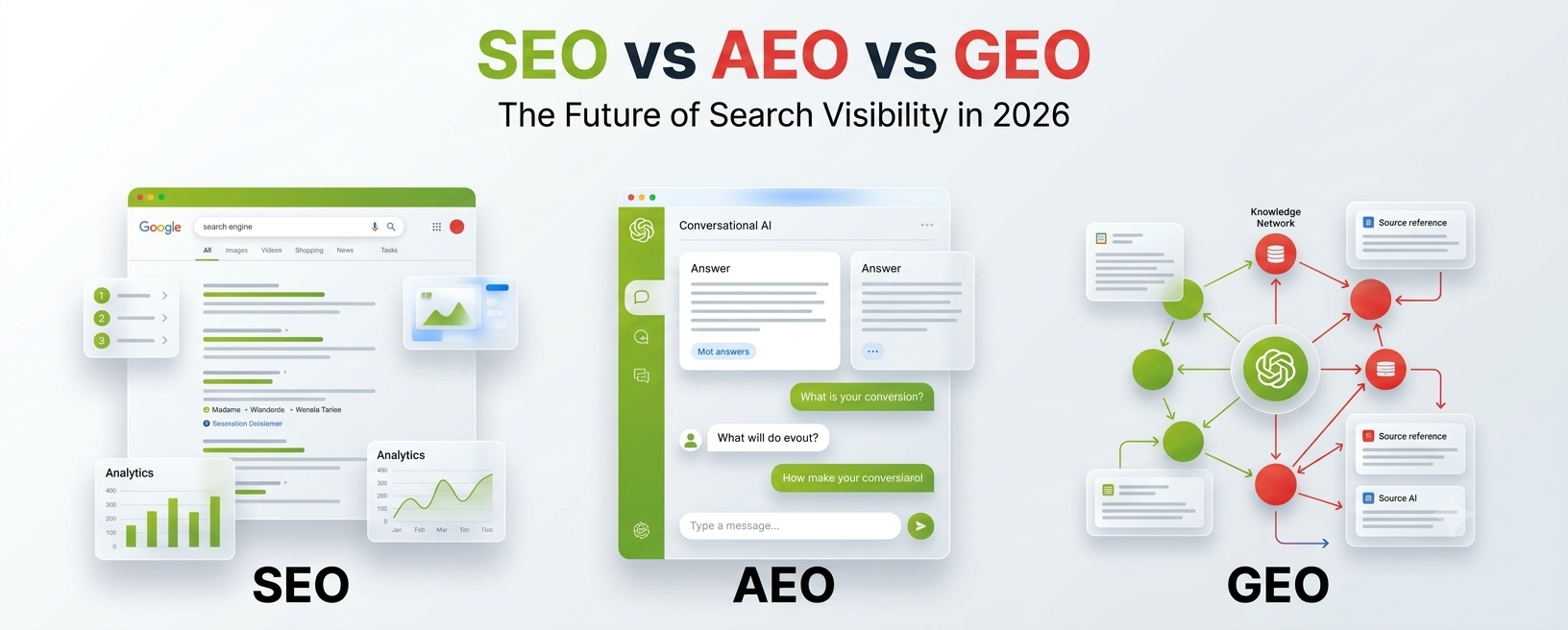
The main difference is the visibility objective.
SEO improves search discoverability, AEO emphasizes answering user questions, and GEO focuses on visibility within generative AI experiences.
These categories overlap significantly. Strong technical SEO and useful content remain important foundations for all three approaches.
Why Should Businesses Focus on AI Search Optimization in 2026?
Customer discovery is becoming more conversational.
Instead of searching only for short keywords, users increasingly ask detailed questions, compare different solutions and request personalized recommendations.
For example:
-
Traditional search: "SEO agency Chennai"
-
Conversational search: "Which SEO services are useful for a new e-commerce website?"
-
Generative search: "Compare SEO and paid advertising for a small business with a limited marketing budget."
Each search represents an opportunity to reach customers at different stages of their purchasing journey.
Businesses that invest in clear, informative and trustworthy digital content may improve their ability to participate in these experiences.
Benefits of a Combined Approach
Broader online visibility: Reach potential customers through traditional search and AI-powered discovery channels.
Better customer education: Explain complex services through useful articles, comparisons and FAQs.
Stronger brand authority: Establish expertise using informative content and credible supporting information.
Improved content quality: Build organized, accessible resources that are valuable to readers.
Long-term marketing value: Develop a content foundation that can adapt as search interfaces evolve.
The goal is not to abandon traditional SEO. It is to extend an existing SEO strategy to support changing customer search behavior.
How to Optimize Your Website for SEO, AEO and GEO
Businesses can begin with a practical, integrated optimization plan.
Step 1: Strengthen Technical SEO
Make sure search engines can crawl and index important website pages.
Improve mobile usability, fix broken internal links, use descriptive URLs and address significant website performance problems.
Step 2: Research Customer Questions
Identify common questions your target audience asks before choosing a product or service.
Use these questions to plan blog articles, FAQ sections and service-page content.
Step 3: Create Helpful, Original Content
Publish informative articles with practical examples, clear explanations and accurate references.
Avoid producing large volumes of repetitive content solely to target keywords.
Step 4: Optimize Content Structure
Use meaningful headings, short paragraphs, comparison tables and relevant examples.
Place important answers where readers can find them easily, while preserving enough context for accuracy.
Step 5: Build Credibility
Add relevant company details, transparent author information, case studies where available and genuine industry references.
Step 6: Support AI Search Discoverability
Keep important content available in accessible HTML, maintain accurate business information and follow search engine indexing guidelines.
Step 7: Monitor Search Performance
Use Google Search Console and analytics tools to track organic traffic, search impressions, clicks and conversions.
For AI search, review available referral traffic and manually assess relevant brand mentions or citations. These measurements may be incomplete because AI platforms differ in reporting capabilities.
Common SEO, AEO and GEO Mistakes to Avoid
Businesses should avoid practices that weaken content quality or create unrealistic expectations.
Keyword stuffing: Repeating keywords excessively reduces readability and does not create useful content.
Publishing generic AI-generated articles: Content without original insights or meaningful value can struggle to distinguish itself.
Ignoring technical SEO: Valuable content may remain difficult to discover when important webpages cannot be crawled or indexed properly.
Using unsupported claims: Inaccurate statistics, exaggerated service claims and misleading testimonials can damage credibility.
Expecting guaranteed AI recommendations: No agency can legitimately promise consistent inclusion in every ChatGPT, Gemini or AI search response.
A sustainable optimization strategy prioritizes credibility, usefulness and continuous improvement.
How SEOAD Can Help Businesses Improve Search Visibility
As businesses adapt to AI-powered search, a coordinated digital visibility strategy becomes increasingly important.
SEOAD offers services covering traditional SEO, Answer Engine Optimization and Generative Engine Optimization, helping businesses explore opportunities across multiple search environments.
From on-page SEO and local SEO to optimization strategies focused on ChatGPT, Google Gemini, Microsoft Copilot and other AI search platforms, SEOAD brings these services together within a broader digital marketing offering.
Businesses seeking stronger search visibility can explore SEOAD's service categories to identify solutions aligned with their marketing objectives.
Visit https://seoad.in/ to learn more about SEO, AEO and GEO services.
Frequently Asked Questions
1. What is the main difference between SEO, AEO and GEO?
SEO focuses on organic search visibility, AEO emphasizes making content useful for direct answers, and GEO focuses on improving discoverability and references within generative AI responses.
2. Is SEO still important in 2026?
Yes. SEO remains essential for search engine discovery, indexing and organic visibility. These fundamentals also support many AI-powered search experiences.
3. Can AEO help my business appear in ChatGPT?
AEO techniques can make business content clearer, more useful and easier to discover. However, appearance in ChatGPT responses is not guaranteed.
4. Do small businesses need GEO?
Small businesses can benefit from GEO principles when their customers use AI platforms to research products, services or providers. It is generally best to begin with strong SEO fundamentals.
5. Which is better: SEO, AEO or GEO?
These approaches work best as complementary strategies. Businesses should first build a technically sound website with useful content, then expand their efforts toward answer-focused and generative search visibility.
Conclusion
The future of digital search is not limited to traditional keyword rankings. AI-powered platforms are introducing new ways for customers to discover information, compare services and evaluate businesses.
Understanding SEO vs AEO vs GEO helps organizations develop a more complete approach to digital visibility.
SEO provides the foundation for search discoverability. AEO encourages useful, question-focused content. GEO extends the strategy toward visibility in generative AI experiences.
By combining these approaches, businesses can create a stronger, more adaptable online presence in 2026 and beyond.
Want to improve your website's visibility across search engines and AI platforms? Explore SEOAD's SEO, AEO and GEO services at https://seoad.in/.