

Introduction: Your Next Customer Could Discover You Anywhere
Imagine someone looking for a reliable service provider. They might begin with Google, ask ChatGPT for recommendations, watch a YouTube review, explore an Instagram profile, or click an advertisement.
The customer journey is no longer a straight line from search to purchase.
For businesses in 2026, the challenge is not simply getting noticed. It is building a recognizable brand that people can discover, understand, trust, and confidently choose.
An effective Digital Brand Growth Strategy connects organic visibility, AI-powered discovery, social engagement, helpful content, and targeted advertising.
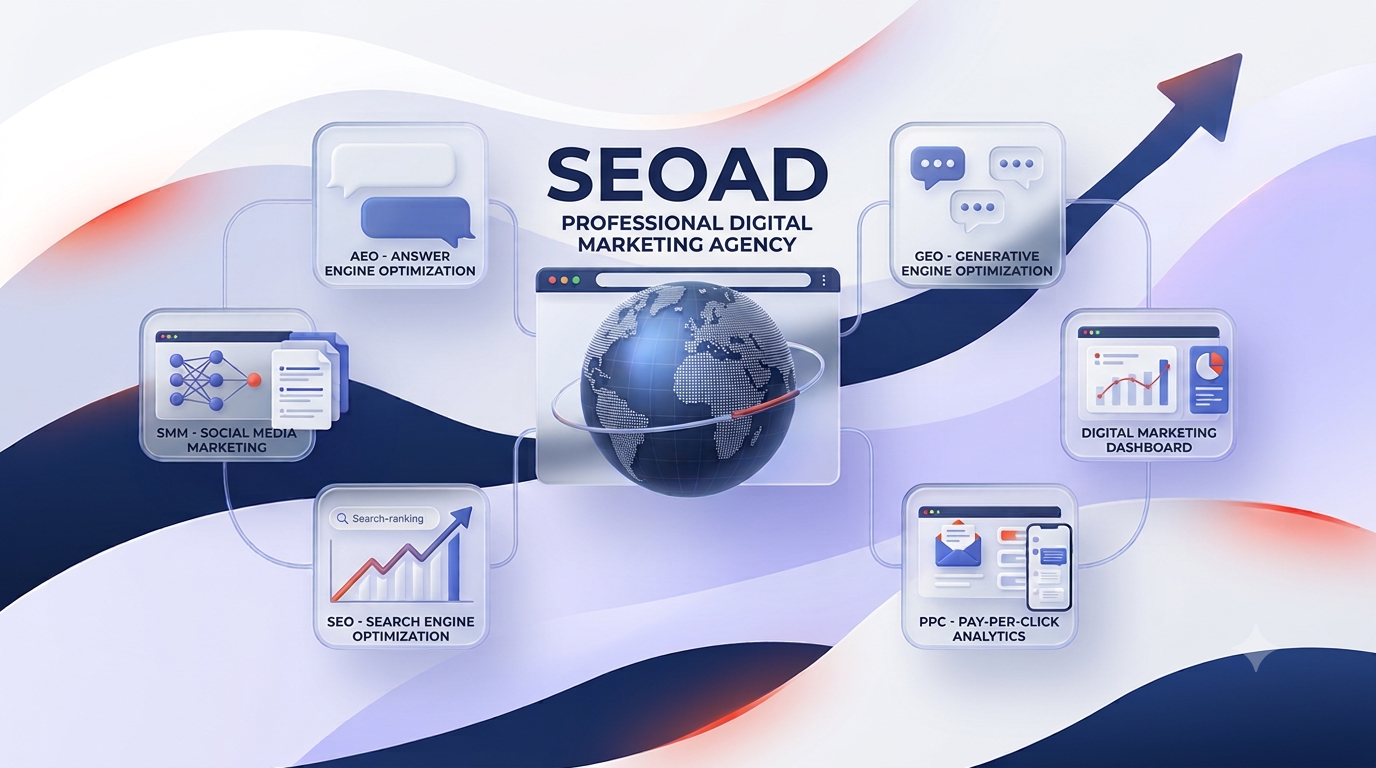
At SEOAD, this approach brings together six important areas: Answer Engine Optimization (AEO), Generative Engine Optimization (GEO), Search Engine Optimization (SEO), Social Media Marketing (SMM), Digital Marketing (DM), and Pay Per Click (PPC).
Let's explore how these services support different stages of a customer's decision-making journey.
1. The Discovery Stage: Help Customers Find Your Business
Before customers compare prices or contact a company, they need to discover that the business exists.
This makes Search Engine Optimization (SEO) a fundamental part of digital growth.
A well-optimized website communicates clearly with search engines while giving visitors useful information.
On-Page SEO improves titles, headings, internal links, URLs, and content organization. Off-Page SEO focuses on earning relevant mentions, backlinks, and credibility beyond the website.
For businesses selling products online, E-Commerce SEO makes product and category pages easier to discover through relevant searches.
Meanwhile, Content SEO connects customer questions with genuinely useful answers, helping businesses attract visitors during their research process.
Location-based companies can benefit from Local SEO, which supports visibility for relevant searches in their service areas.
Businesses targeting different regions may also use Multilingual SEO to reach audiences through properly localized content.
Practical example: A Chennai-based supplier could develop separate pages for its products, industries served, frequently asked questions, and regional markets. This gives prospective buyers clearer paths to relevant information.
The objective is not just more visitors. It is attracting people who have a real interest in the business.
2. The AI Discovery Stage: Become Part of the Conversation
Search behavior is changing as customers use conversational AI to compare products, understand services, and research companies.
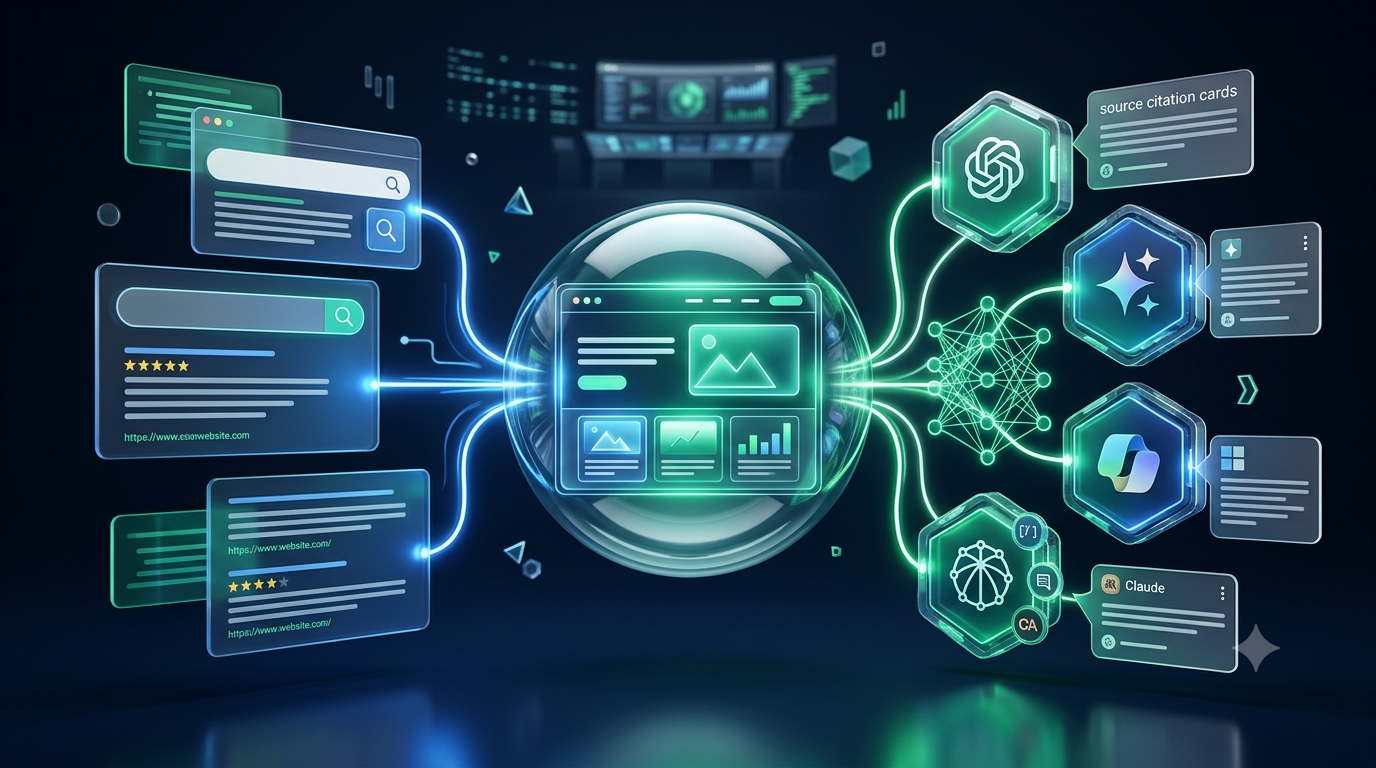
Answer Engine Optimization (AEO) helps businesses create clear, relevant, well-structured information that can be understood by answer-oriented systems.
SEOAD's AEO-related platform services include ChatGPT, Google Gemini, Microsoft Copilot, Perplexity, Claude AI, Meta AI, and You.com.
These platforms are not identical. Some retrieve live information, others use different sources or response-generation methods, and not every answer provides website citations.
Still, clear service descriptions, accurate company information, evidence-backed expertise, and helpful FAQs can improve how easily a brand's information is understood and discovered.
Consider a customer asking:
“What should I look for when choosing an industrial equipment supplier?”
A company that publishes specifications, selection criteria, certifications, and maintenance advice offers much greater research value than a website containing only promotional claims.
That is where meaningful AI Search Optimization begins.
3. The AI Visibility Stage: Build Information Worth Referencing
While AEO emphasizes helpful answers, Generative Engine Optimization (GEO) focuses on improving how accurately and prominently a brand may be represented in AI-generated discovery experiences.
SEOAD lists services associated with Google Search AI, Microsoft Bing AI, DuckDuckGo AI, and Substack.
These channels serve different purposes. Google and Bing provide search experiences with AI features, DuckDuckGo offers AI-assisted discovery, while Substack can support expert publishing and audience development rather than functioning as a conventional search engine.
A practical GEO strategy should prioritize original insights, transparent authorship, current business details, relevant citations, and consistency across digital properties.
For example, a manufacturer publishing an original product comparison with clear technical explanations creates content that can help customers and potentially inform AI-assisted research.
However, no company can guarantee that an AI platform will recommend or cite a particular brand.
The sustainable goal is to make business information credible, accessible, and genuinely useful.
4. The Trust Stage: Turn Brand Awareness into Real Connections
Finding a company online is only the beginning. Customers often check its social presence before deciding whether to inquire.
This is where Social Media Marketing (SMM) supports reputation, communication, and familiarity.
Facebook Marketing helps businesses share updates and engage with communities, while Instagram Marketing uses visual storytelling, product demonstrations, and short-form content.
For B2B organizations, LinkedIn Marketing can highlight professional expertise, industry insights, and company achievements.
X (Twitter) Marketing supports timely conversations and announcements, while YouTube Marketing provides opportunities for tutorials, demonstrations, and educational videos.
Businesses can also explore TikTok Marketing for short-form storytelling, Pinterest Marketing for visual discovery, and Reddit Marketing for authentic participation in relevant discussions.
Local discoverability also matters. Google My Business, now known as Google Business Profile, supports business information and customer reviews, while Bing Map Promotion can improve the completeness of a company's presence in Microsoft's local search ecosystem.
The most important principle is consistency.
A brand that communicates clearly, responds thoughtfully, and provides useful information is better positioned to earn trust than one that only publishes advertisements.
5. The Engagement Stage: Keep Conversations Moving
Not every visitor is ready to become a customer immediately.
Some need more information. Others want to compare alternatives or discuss requirements with their teams.
This is where broader Digital Marketing (DM) activities help businesses maintain meaningful contact.
WhatsApp Marketing enables timely, permission-based customer communication, while Email Marketing supports newsletters, product updates, follow-ups, and relationship building.
Video Marketing can explain complicated products or demonstrate services in a format that customers find accessible.
Consistent Blog Posting helps answer industry questions, and Quora Marketing creates opportunities to contribute relevant expertise through useful responses.
Forum & Microblogging can encourage professional discussion when participation is authentic rather than promotional spam.
Other supporting activities include Classified Listing on suitable business platforms and Link Submission to relevant, reputable directories where listings provide genuine value.
Wikipedia Services should focus on policy-compliant, neutral, properly sourced information where appropriate, rather than promotional editing or guaranteed page creation.
Finally, Reputation Management helps businesses monitor reviews, respond professionally, address concerns, and maintain accurate public information.
Together, these activities support customer confidence throughout a longer buying cycle.
6. The Conversion Stage: Reach Customers Ready to Act
Organic discovery builds long-term opportunities, but businesses sometimes need immediate visibility for product launches, seasonal campaigns, or lead generation.
Pay Per Click (PPC) advertising can help reach a carefully defined audience.
Google Ads allows companies to advertise for relevant search terms and across eligible Google advertising placements.
Meta Ads enables campaigns across Facebook, Instagram, and other supported placements based on campaign objectives and targeting options.
A strong paid campaign begins with a business goal, not simply an advertising budget.
For example, an engineering company might direct high-intent search traffic to a quotation page, while a consumer brand could use visual advertisements to introduce a new product.
Campaign performance should be evaluated through qualified leads, conversion rates, acquisition costs, and revenue contribution—not clicks alone.
The best results often come when advertising and organic marketing support the same message.
7. What an Integrated Customer Journey Actually Looks Like
Consider a business looking for a new software service.
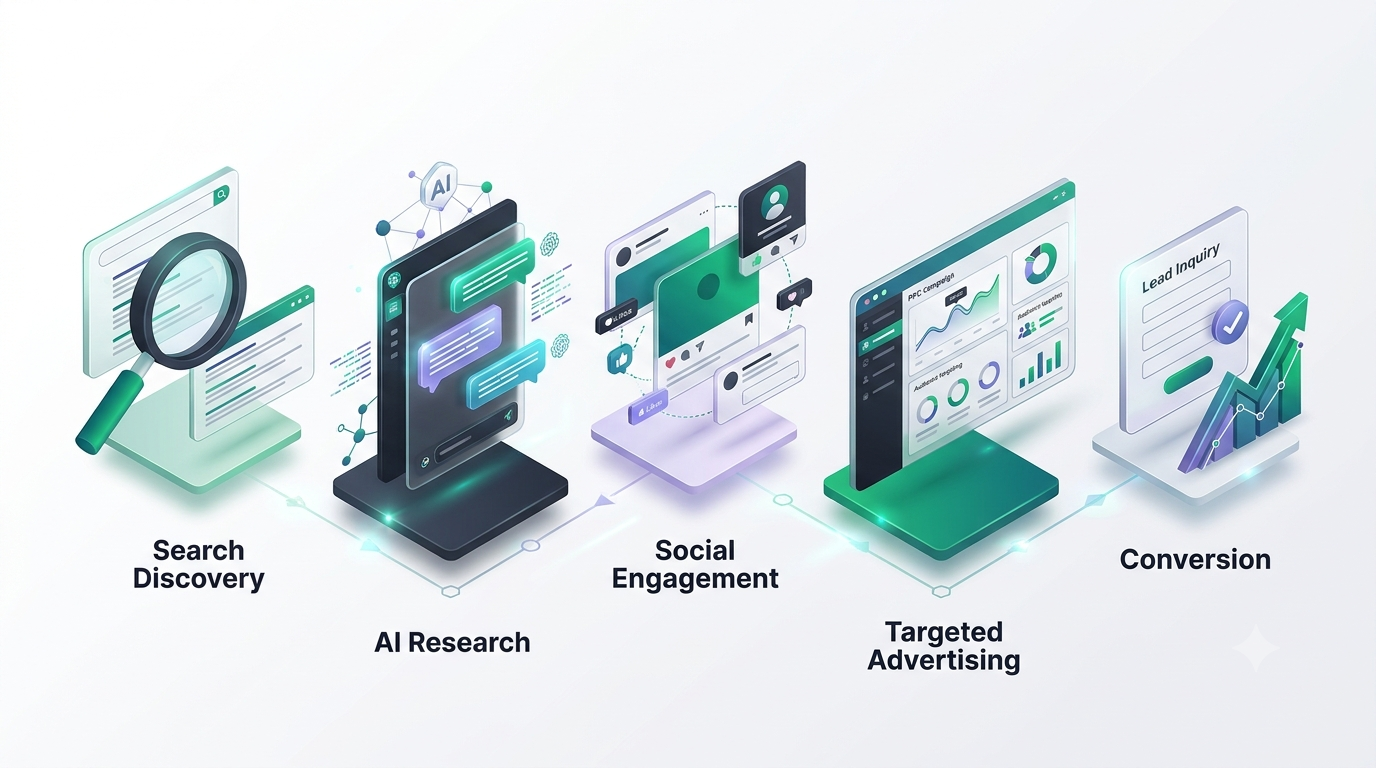
First, the decision-maker discovers an educational article through Google. Later, they ask an AI assistant to explain different solutions and compare available options.
They visit a company's LinkedIn profile, watch a product demonstration on YouTube, and read customer reviews.
A few days later, a relevant advertisement reminds them about the service.
Finally, they return to the website, review the company's expertise, and request a consultation.
Several digital channels contributed to this single inquiry.
This is why businesses should avoid evaluating every marketing activity in isolation. Search visibility introduces the brand, educational content supports consideration, social channels reinforce credibility, and well-targeted campaigns encourage action.
A coordinated customer experience is more valuable than disconnected promotional efforts.
8. Measure Business Growth Beyond Rankings and Followers
Successful digital marketing requires more than attractive dashboards.
Businesses should connect marketing performance with actual customer behavior.
Useful indicators include organic search impressions, qualified website traffic, AI citation observations, social engagement, contact-form submissions, advertising conversion rates, and customer acquisition costs.
AI visibility reporting should also distinguish between a brand being mentioned, cited as a source, and receiving measurable referral traffic.
For growing companies, monthly reporting can reveal which channels produce meaningful inquiries and where customers encounter difficulties.
These insights allow teams to improve content, landing pages, messaging, and campaign budgets over time.
9. How SEOAD Supports a Connected Digital Presence
SEOAD offers services across organic search, AI-oriented discovery, social media, digital engagement, and paid advertising.
Its website emphasizes manually developed, white-hat strategies and services designed around business visibility and customer acquisition.
Businesses can explore SEO Services, AEO Services, GEO Services, social campaigns, and performance advertising based on their goals, competition, target market, and available resources.
Rather than treating every channel as a separate activity, the stronger approach is to give each one a specific role in customer acquisition and brand development.
Frequently Asked Questions
1. What is a digital brand growth strategy?
A digital brand growth strategy combines search visibility, content, social media, customer engagement, and advertising to help a business attract relevant audiences and convert interest into measurable opportunities.
2. What is the difference between SEO, AEO and GEO?
SEO improves search engine visibility, AEO focuses on making information suitable for direct answers, and GEO aims to improve a brand's representation in AI-generated discovery experiences. These approaches overlap but have different areas of emphasis.
3. Can businesses appear in ChatGPT and Google Gemini results?
Businesses may be mentioned or cited when their information is relevant and accessible to supported AI experiences. Visibility depends on each platform's systems and cannot be guaranteed.
4. Why is social media important for business growth?
Social platforms help customers evaluate brand credibility, understand products, view company activity, and communicate with businesses before making purchase decisions.
5. Should a business invest in SEO or PPC first?
It depends on the objective. SEO supports longer-term organic discovery, while PPC can provide faster paid visibility. Businesses often benefit from combining both with clear budgets and conversion tracking.
6. How can a company measure AI search visibility?
Companies can monitor brand mentions, source citations, relevant prompt categories, AI referral traffic where available, and resulting leads. Reporting should acknowledge variation between platforms and queries.
7. Does digital marketing work for small businesses?
Yes. Small businesses can begin with a focused website, local search presence, customer reviews, and one or two relevant marketing channels before expanding their activities.
8. How does SEOAD help businesses improve digital visibility?
SEOAD provides SEO, AEO, GEO, social media marketing, digital marketing, and PPC services that businesses can combine according to their audience, goals, and growth priorities.
Conclusion: Build a Brand That Deserves to Be Discovered
Digital success in 2026 is about more than reaching the first page of search results.
Customers expect clear answers, trustworthy information, useful experiences, and consistent communication wherever they discover a business.
A connected strategy helps brands move from visibility to familiarity, from familiarity to trust, and from trust to meaningful customer relationships.
SEOAD helps businesses explore this broader approach through search optimization, AI visibility, social media, digital marketing, and paid advertising.
Ready to strengthen your online presence?
Visit https://seoad.in/ to explore SEOAD's digital marketing services and request a strategy suited to your business.